Cherokee Nation Tribal Code, Notary Laws
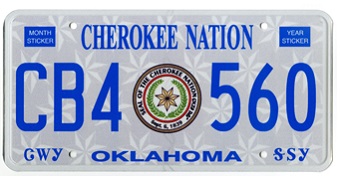 The Cherokee Nation is the federally-recognized government of the Cherokee people and has sovereign nation status recognized by treaty and law.
The seat of tribal government is in Tahlequah, in northeast Oklahoma, formerly Indian Territory, the capital of the Cherokee Nation. The Cherokee Nation includes 14 counties, covering 7,000 square miles, with over 330,000 registered citizens, including over 200,000 living at-large, outside of the 14 counties. It is the largest Native American tribe in the United States.
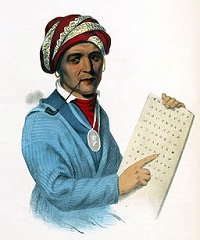
The Cherokees were the first Indian tribe to develop a written alphabet, known as the Cherokee syllabary, developed in 1821 by inventor and statesman Sequoyah (see image).
The government includes three branches: legislative, executive and judicial. The Tribal Council, with legislative power, has 17 members, elected to 4-year terms. Executive power is vested in the Principal Chief, also elected to a 4-year term.
The judicial branch includes the District Court, and the Supreme Court, with 5 judges, appointed by the Principal Chief.
The tribal code includes laws governing Cherokee tribal notaries.
Cherokee Tribal Notaries
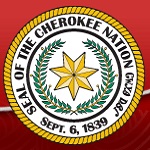
Notaries in the Cherokee Nation are appointed and commissioned to a 4-year term by the Principal Chief, or his designee. An applicant must be a citizen of the Cherokee Nation, at least age eighteen. The commission is sealed with the Seal of the Cherokee Nation.
The notary must file his oath of office, official signature, an impression of his notary seal, and a $1,000 bond with the Court Clerk, along with a $25 filing fee.
The official notary seal shall be a metal seal containing the notary’s name and county of residence. All notarial acts must include the jurisdiction, date, notary signature, notary seal, and commission expiration date.
Cherokee Notary Authority
Cherokee notaries have authority within the Cherokee Nation:
to make the proof and acknowledgement of deeds and other instruments,
to administer oaths and affirmations,
to demand acceptance or payment of foreign or inland bills of exchange and promissory notes,
to protest the same for nonacceptance or nonpayment,
to exercise other powers and duties as by law of nations and commercial usage may be performed by notaries public,
to witness or attest a signature, and
to certify or attest a copy.
A notarial act may be performed within the Cherokee Nation by a Cherokee tribal notary, or by an Oklahoma state notary.
Notary Recordkeeping
For protests for banks, the Cherokee Nation notary shall keep a register in a book provided for that purpose by the bank.
Every notary shall keep a fair record of his official acts, and shall give a certified copy of any notarial record, if required, upon receipt of fee payment.
At the end of the notary’s career, the notary records must be delivered to the Court Clerk.
Satisfactory Evidence of Identification
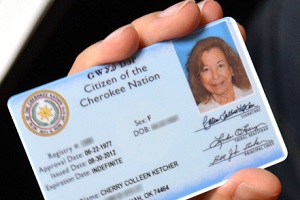 The signer may be identified if that person is personally known to the notary,
is identified upon oath or affirmation of a credible witness known to the notary,
or on the basis of identification documents.
Cherokee Notarial Certificates
1. Short form certificate for acknowledgment:
Cherokee Nation
State of
County of
This instrument was acknowledged before me on (date) by (name(s) of person(s)).
____________________
(Signature of notarial officer)
(Seal, if any)
____________________
Title (and Rank)
(My commission expires: )
2. Short form certificate for oath or affirmation:
Cherokee Nation
State of
County of
Signed and sworn to (or affirmed) before me on (date) by (name(s) of person(s) making statement).
____________________
(Signature of notarial officer)
(Seal, if any)
____________________
Title (and rank)
(My commission expires: )
3. Short form certificate for witnessing or attesting a signature:
Cherokee Nation
State of
County of
Signed or attested before me on (date) by (name(s) of person(s)).
____________________
(Signature of notarial officer)
(Seal, if any)
____________________
Title (and rank)
(My commission expires: )
4. Short form certificate for attestation of a copy of a document:
Cherokee Nation
State of
County of
I certify that this is a true and correct copy of a document in the possession of _____ Dated _____
____________________
(Signature of notarial officer)
(Seal, if any)
____________________
Title (and rank)
(My commission expires: )
Cherokee Notary Laws
Here is a copy of the Cherokee Nation Tribal Notary Laws.
There are about 600 federally recognized Native American tribes. Some of them use tribal notaries, but most use state notaries.
Note: Also see our blog articles on Native Americans, Tribal ID and Indian Territory Notaries.
Image credits:
1. Cherokee license plate, 3. Cherokee Seal, 4. Cherokee ID card, from Cherokee Nation, Fair Use for education
2. Sequoya portrait, by lithographer: Lehman and Duval (George Lehman (d.1870); Peter S. Duval) Painter: Henry Inman (1801-1846); copy after a painting by Charles Bird King (1785-1862) which was lost in a fire in the Smithsonian in 1865. [Public domain], via Wikimedia Commons
Visit our website for Colorado Springs Mobile Notary services or Colorado Notary Training classes.
© Copyright 2016 ABC Legal Docs, LLC All rights reserved. Do not copy. Citations welcome. Terms of Use apply.

Hi, I have a few questions regarding the Cherokee notary public seal:
I see a metal notarial seal is required, just to be clear a stamp is NOT allowed?
Is there any other required info for the seal? What I’m finding is the Cherokee Seal, name and county of residence. Is the commission expires allowed on the seal?
Thanks Nikki Stresemann
The laws for the Cherokee Nation, headquartered in Tahlequah, OK, are found in the tribal code on their Attorney General website. Title 49, Chapter 1, Section 5 describes the requirements for a notary seal. Contact an attorney for legal advice.
Thanks ABCLegalDocs! As always, well-researched, informative, and factual. Great article for notaries who are seeking information about notarizing on tribal property.
Thanks for your comment, Brenda.
I have not seen other articles written on the topic of Native American tribal notaries. Most notaries do not know that tribal notaries exist. The Colorado SOS was not aware of it.
I also got a message from a notary in northeast Oklahoma, in Cherokee country, who was not aware of it, and shared it on her social media.
One of my customers was a Native American, related to Lakota Sioux Chief Crazy Horse. Tribal ID is an acceptable form of ID in Colorado, but rarely seen. Our Native American population in Colorado is less than 1%.